
Case study
Bytloop POS
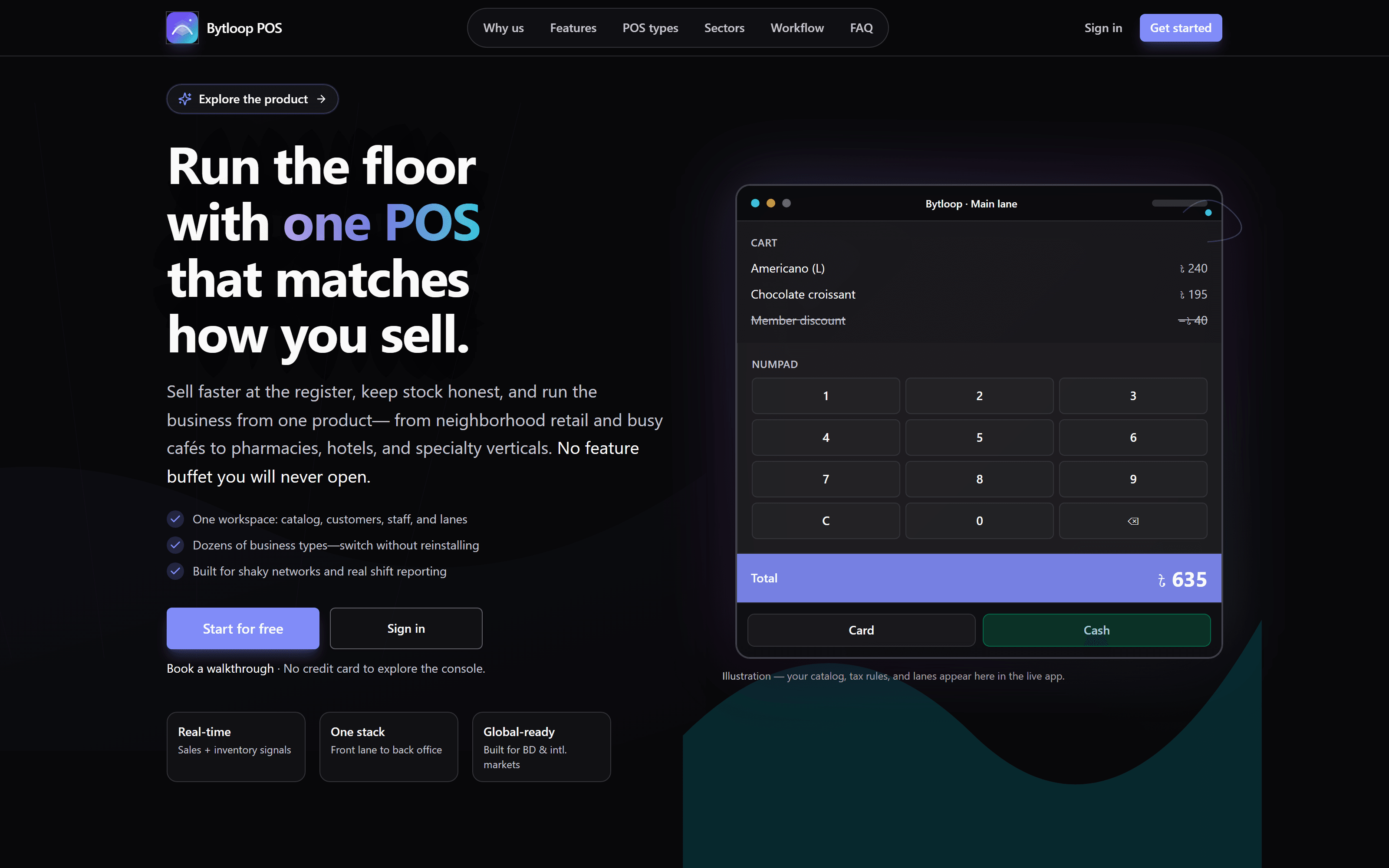
One point-of-sale engine that runs a corner shop, a restaurant line, a pharmacy counter, or a hotel front desk — without turning into five different products underneath.
- Sector
- Retail & hospitality — point of sale
- Built with
- Next.js
- Scope
- Register, inventory, verticals, AI ops tooling
The problem
One POS shouldn't mean one kind of business
Most point-of-sale software specializes early: a kitchen-display-and-modifiers product built for restaurants, a barcode-and-inventory product built for retail, a booking product built for hotels, each from a different vendor assuming a different floor. An operator running more than one kind of location — or growing into a second one — ends up stitching separate systems together, or picking whichever product is close enough and living with the gap.
Bytloop POS's answer is structural rather than a marketing line: catalog, customers, staff, and permissions live in one workspace no matter the vertical, and “business type” is a setting a manager changes, not a different product to migrate into. Retail, food and beverage, pharmacy, hotels, and dozens of other formats run on the same engine, each surfacing its own controls.
What we built
The same register, tuned per floor
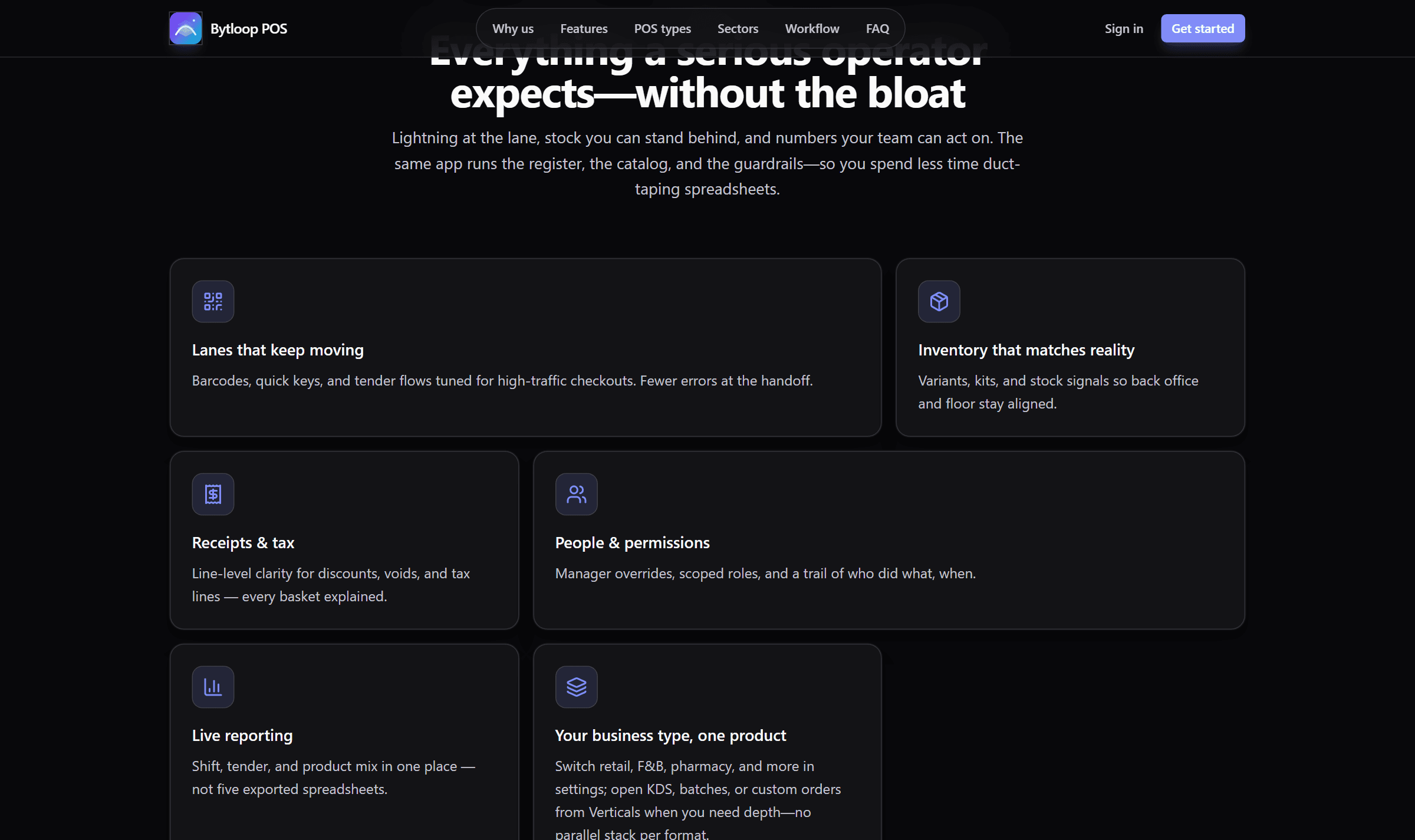
The lane itself is built for the busiest moment of the day: barcode and quick-key checkout, tender flows tuned for high-traffic registers, and line-level clarity on every discount, void, and tax line so a disputed receipt has an actual explanation instead of a shrug. Inventory tracks variants and kits, not just single SKUs, and stock signals stay shared between the back office and the floor rather than reconciled at closing. Roles are scoped with manager overrides and an audit trail, so finance can see who voided what and when without asking around.
Vertical depth
A candy bar and a diamond ring don't sell the same way
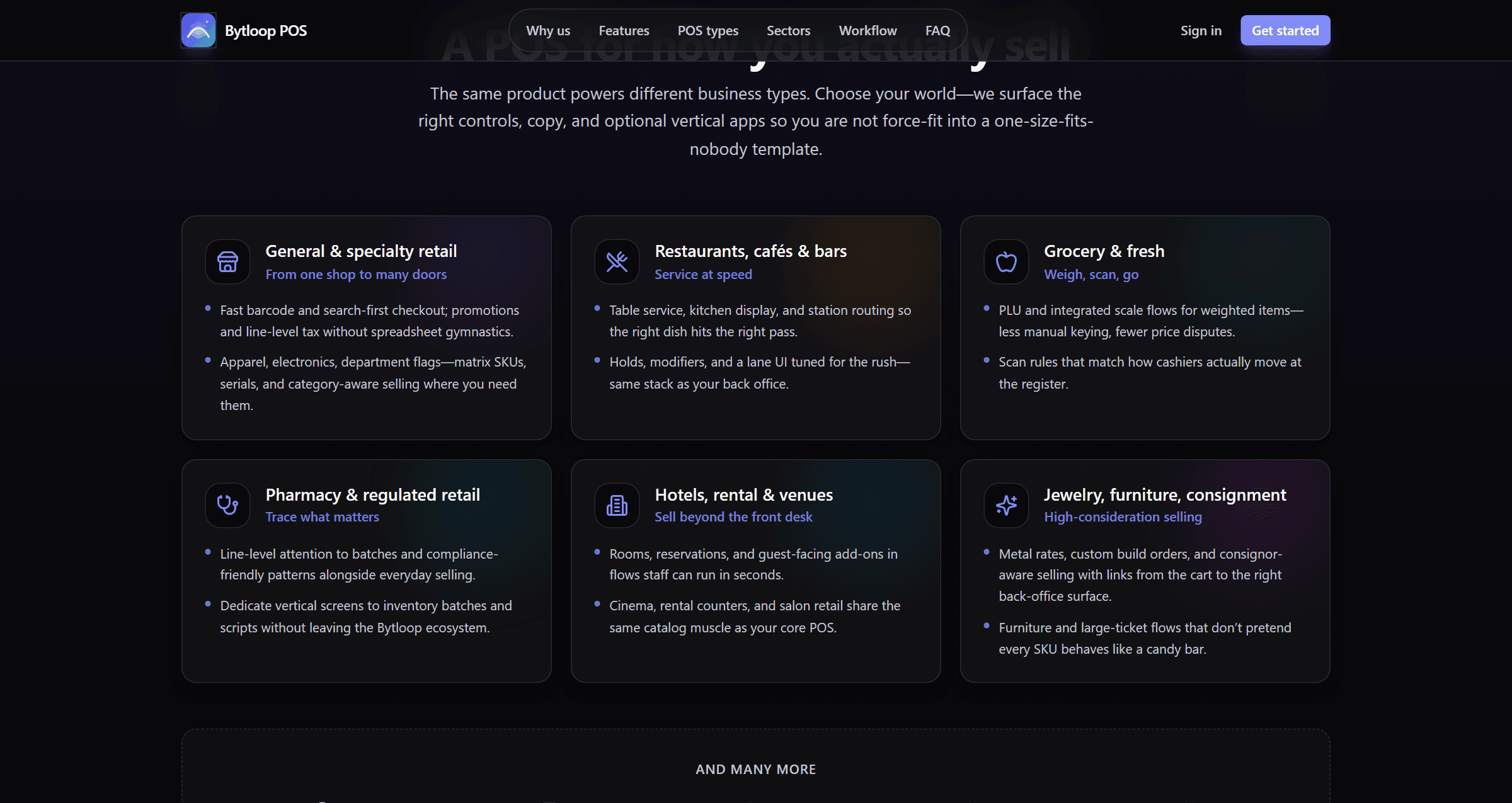
This is where the “one POS” claim gets tested. Retail gets matrix SKUs and category-aware selling; restaurants get kitchen-display routing and modifiers tuned for a rush; grocery gets PLU codes and integrated scale flows so a weighed item doesn't need a manual price key-in; pharmacy gets batch tracing and compliance-friendly patterns; hotels get room and reservation flows staff can run in seconds; jewelry, furniture, and consignment sellers get metal-rate pricing and consignor-aware selling instead of being treated like every SKU behaves like a candy bar. Field services, nightlife, salons, and half a dozen other formats run on the same core with their own controls — and a business without a dedicated module yet still gets a register shaped by the mode it's set to.
Where the AI sits
In the decisions, not in the checkout flow
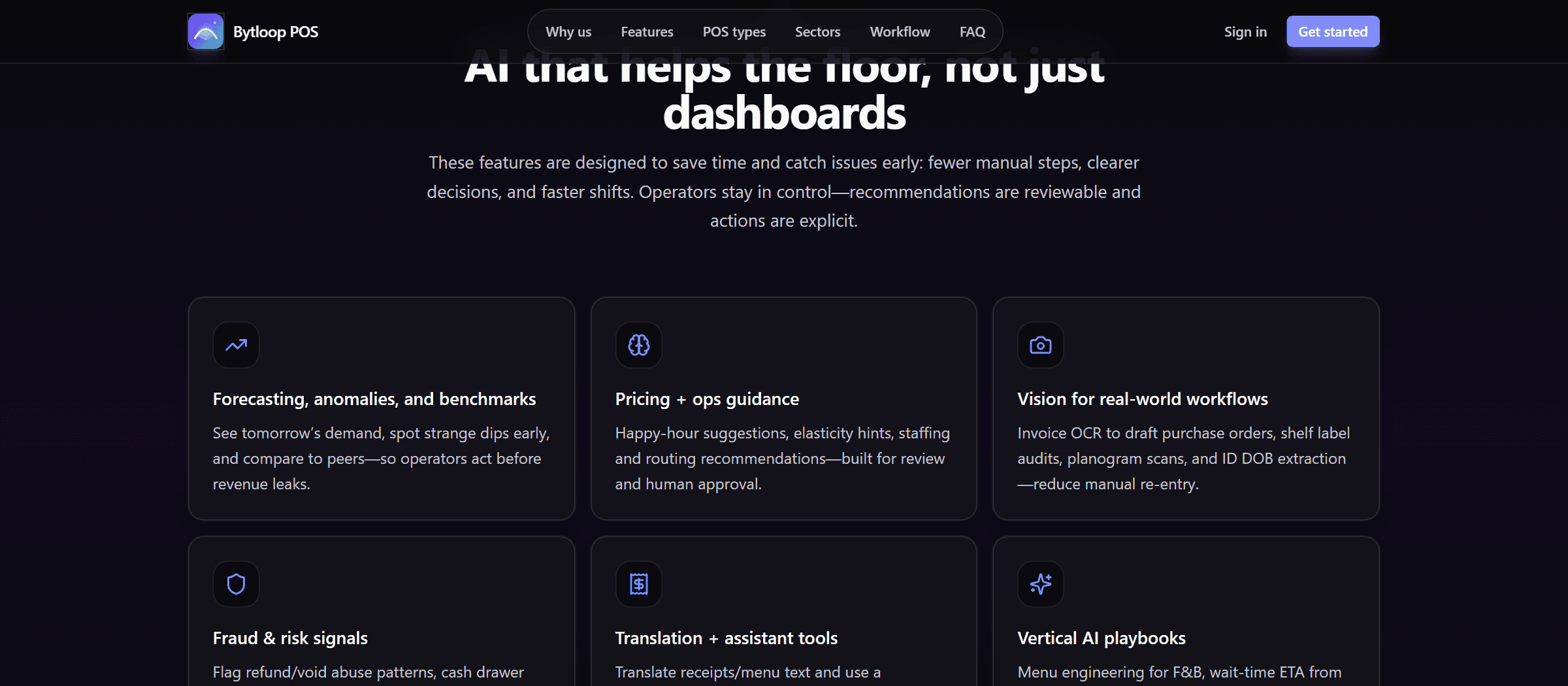
The AI features stay out of a cashier's way and sit in the operator's decisions instead. Demand forecasting and anomaly detection flag a strange dip before it becomes a quarter of lost revenue instead of after. Invoice OCR drafts purchase orders from a supplier invoice, and the same vision layer handles shelf-label audits, planogram scans, and ID date-of-birth extraction for age-restricted sales — the manual re-entry a cashier used to do by hand. Fraud and risk signals flag refund and void abuse patterns, cash-drawer discrepancies, and card-testing-shaped tap anomalies, but nothing acts on its own: recommendations are reviewable and every action stays explicit. The playbooks go deeper by vertical too, down to menu engineering for restaurants and wait-time estimates pulled from kitchen-display load.
Engineering notes
Built to keep selling when the network doesn't cooperate
A POS that stops working when a router hiccups costs a business real money at the worst possible moment, so offline tolerance isn't a fallback mode bolted on afterward: a charge taken offline saves locally and syncs the moment connectivity returns, and the lane keeps moving instead of blocking on a spinner. Auth, TLS, and service boundaries are built zero-trust throughout, assuming a hostile network rather than a trusted one — which matters more for a register sitting on whatever Wi-Fi a location happens to have than it does for most software. Health checks, traces, and alerts live in the platform layer itself, so an incident gets caught before it turns into a line at the register during a lunch rush, not after.
Where it stands
Built for Bangladesh and international markets from day one
Currency and formatting handle Bangladeshi Taka as a first-class case rather than a workaround, while the same core serves international operators. Onboarding runs in three phases: organize the business (org, locations, and staff access), model the real world (catalog, taxes, and lane profiles that reflect how the business actually runs rather than a demo dataset), and go live with reporting that updates through the shift instead of getting reconciled at closing. There's no credit card required to explore the console, and for larger rollouts the team helps plan data migration and training rather than leaving a multi-site operator to figure out go-live alone.
Start a project
Building something like this?
We take on a handful of builds at a time so every one of them gets this kind of attention. Tell us what you're trying to ship.